Receive Our Newsletter
For news of readings, events and new titles.

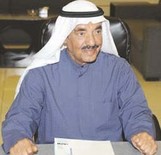
I was in Baghdad on a business trip with the representative of the Sakhr Software Company. At the weekend, I decided to go to visit the birthplace of al-Mutanabbi in Kufa, the town of Karbala where al-Hussein was martyred, and the famous religious and cultural site of Najaf. In Kufa, I walked to the mosque of the Imam Ali, where my eyes wandered over the courtyard of the Great Mosque. As my eyes were searching for a way of connecting with its history and rituals, I was suddenly approached by a young man wearing a green turban on his head and a cloak over his shoulders. He greeted me warmly with a friendly look, then asked whether this was the first time I had visited the shrine. I said I was looking for a guide to show me around and explain things to me. “I’ll be your guide,” he replied. We began to walk together. I could see crowds of men and women sitting on the ground with others wearing turbans. I thought that perhaps they had been asking about the rituals like me. But the guide told me that these people had made vows and had come to pay the money they had promised God to pay if their wishes came true – like a woman if she became pregnant, or a young man if his girlfriend came back to him, a farmer if he sold his crop for a large profit, or an old man if his son returned from war, and many more such.
We went into the shrine, which was surrounded by an enormous metal fence, parts of which were gilded, perhaps actually perfumed. People were crammed there uncomfortably close together, stretching out their hands over the fence as they begged forgiveness for a sin or sins or sought mercy from the Lord of the Worlds. Some of them had tears running down their cheeks. The guide began explaining to me about the tragedy and misfortunes of the Prophet’s family and about the martyrdom of al-Hussein that we had read about, then suddenly stopped and looked at me: “Are you a Sunni?”
“Yes,” I replied. “How did you know?”
“Because you do not weep.”
“But these are facts we’ve read time and time again in the history books,” I replied.
He turned his face away from me, disgusted at my answer.
“You think they are just history?” he asked.
“I know all these facts and I know who summoned Hussein to Kufa and then deserted him,” I replied. He turned his face away and tutted, and I thought I heard him laughing and whispering, but I couldn’t make out what. As we were making our way to go out from the mosque, he stopped in the courtyard, calmly turned his eyes on me and said: “People in the desert just bury their dead and go, isn’t that so? Death, and that’s the end of it! But don’t you see Christians praying and weeping in church and recalling Christ’s crucifixion and pain? They are believers, who know the meaning of sacrifice and pain like us, not just as history. You don’t know the pleasure of suffering. It purifies the soul from the misfortunes and frustrations of the world.” Then he added with a smile: “But perhaps you don’t have any disappointments, and don’t need hope?”
I made no reply but continued walking with him, head bowed. He smiled and looked at me: “You people don’t know how to weep or remember. With you it’s history, just history!”
I asked him to take me with him on a tour of the city of Kufa. I was surprised by this city and its inhabitants. There was not a single school or street or statue of the most famous Arab poet, Abu al-Tayyib Ahmad ibn al-Husayn al-Mutanabbi. “This is a religious city,” he told me, “and al-Mutanabbi was not a believer. We are a people of poetry; many of our people praise al-Mutanabbi and learn his poetry by heart, but we cannot commemorate him because he wasn’t a believer.”
“Kufa was founded and its quarters were planned by ‘Umar ibn al-Khattab. Why don’t you make a statue to him, or a museum for the maps and plans of the city?” He looked at me in disgust and made a gesture: “No, no, we don’t make statues!”
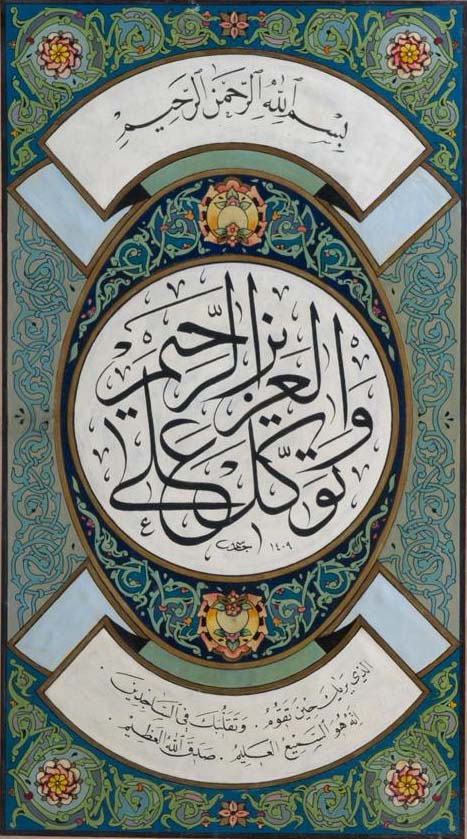 After that he took me to the main market. It was a covered market, its roof maybe of wood, maybe of worn iron sheeting. The floor was compacted earth, and the shops were small and crammed one beside the other. The shopkeepers were sewing men’s bisht cloaks and various sorts of black agals or headbands, as well as the gilded ones that have gone out of use. They decorate the cloaks with gold tassels brought from India. They sit next to other on the ground on old, threadbare carpets, backs bowed, sewing golden threads down the sides of the cloaks with a professional absorption that seems to me debilitating. There are shops doing the same thing on both sides, shop after shop after shop. Nothing in this market except for weavers of cloaks, with the sunrays coming down through gaps in the roof. Suddenly I caught sight of a shop with a wide glass façade. I looked inside and saw several calligraphy panels.
I pushed open the door and went into the shop. At the far end of the shop sat a heavy set man, a rectangular wooden table in front of him. I started to look carefully at the panels. The man didn’t lift a finger. I turned to him to ask the price of a panel in thuluth in pale green lettering. He told me the price sitting where he was. Then I saw a picture in diwani script that looked as though it was in burned lettering. When I asked the price, the man raised his voice: “Do you want to browse or do you want to buy?” “Browse and buy!” I replied. He got up from his chair and came towards me. He had a thick moustache and thick glasses, and the way he was dressed suggested a rough type, with a face worn out by time. I started to ask him about various pieces of calligraphy. “Don’t you like any of them?” he asked me with a grunt. “On the contrary, I like them all,” I replied. He laughed, perhaps sarcastically, and said: “Then buy them all!” “No, not all of them,” I replied. He came up to me to look me over. “Where are you from?” he asked. “From Kuwait,” I replied. “Excellent,” he replied, in a mocking tone. “You people have money!” I looked at him in astonishment. Why all this self-importance and contempt when I’m just a customer who wants to buy what he has for sale?” “Have you got money?” he asked. “Of course, how could I make a purchase without money?” He laughed, and I noticed his enormous white teeth. “I mean, do you have ready money?” “Yes,” I replied. “You have money with you now?” “Yes,” I said. His pleasure was apparent on his face, and his dark, wrinkled face flushed a little. “I’ll give you a discount if you buy three panels,” he said. There were nine or ten panels in the shop. “I’d like this one and this one,” I said, then turned to my left . . . “and this one,” . . . then to the right . . . “and this one and this one.” He reeled off the prices and asked: “You want all these?” “Yes,” I replied. “That’s a lot of money,” he said, “around three thousand dinars, but if you take the rest I’ll give you a two hundred dinar discount.” “But I don’t want them,” I said. “Take them,” he replied. “There are only two left, you’ll like them later. Take them, then I can shut up shop and forget this place.” “Put your trust in God!” I said. “We trust in God!” he replied. He had apparently noticed the young man in a turban walking up and down outside the shop window. He went up to him, said something to him and the guide left – and I never saw him again. “Was he with you?” he asked when he came back. “Yes,” I replied, “he was a guide at the mausoleum and I asked him to take me round the market.” “I sent him away,” he replied. “Why?” “Those people are liars,” he replied, ‘they know nothing about history, they just spout stuff to make women and peasants weep. But you’re obviously educated, what can you learn from him?” “But he helped me and I wanted to reward him for his assistance,” I replied. “It doesn’t matter,” he said. “If you buy these panels, I know him, I’ll find him and I’ll give him a hundred dinars as a present from you.”
He went back to his desk and invited me to sit down. The wooden chair was hard and its legs seemed uneven. He noticed me swaying as I sat there. “You’ll soon settle down and the chair will find a position where it does not sway,” he said. As I sat there he wrote out the names and prices of the panels, gave me an invoice on which he had written ‘Jassim al-Kufi, calligrapher’. Then he asked me when I would take the panels, meaning “when would I pay the money?”. “I don’t have the full sum in my pocket at the moment,” I replied. “I’ll give you a thousand dinars as a deposit and the driver will bring the rest later and collect the panels.” I was on the point of leaving but he raised himself a little from the chair and asked: “Where are you going? Sit down, and drink tea with me.” He put his hand under the desk, brought out a teapot and poured me a glass of strong black tea. I tasted it and it was full of sugar. “Do you have the thousand now?” he asked. “Yes,” I replied. “And you were going to leave without giving it to me?” he asked. I put my hand in my pocket, took out a thousand dinars and gave it to him. He took it in disbelief and began to look at me from behind his thick glasses, his face beaming with delight. He lifted the money to his mouth and kissed it several times, then raised it to his forehead and said: “I’ll give you a present!” As I laughed merrily, he put his hand into one of the desk drawers and took out a flute, then stood up, shut the shop door, went back to his seat and began to play on the flute with an almost divine concentration. The tunes were limpid, joyful, rippling like a morning breeze after light rain. Not a sad flute like you hear country folk play, but music full of joy and delight, of the chirping and dancing of birds leaping from one branch to another. Had this man from Kufa heard Bach’s flute sonatas? I thanked him and stood up to take my leave. “Impossible! I sent the guide away. I’ll be your guide today in Kufa. And what is there in Kufa? What can you see in Kufa? Cloak manufacture and embroidery in this market, and the mausoleum you visited a little while ago with the ignorant guide. Men in turbans everywhere, embroidery on cloaks, tea drinking, and dust most days. I don’t know what sense it makes for me to have been born in this city with my talents. Why be born with my talent in a city where all they do is embroider cloaks and bring in money by making poor people weep? I have a qualification in calligraphy from Ustadh Jassim the calligrapher. How many calligraphers have a certificate from the Ustadh? Ten . . . twenty. The important thing is that I am the last one. Why wasn’t I a tailor, making cloaks? No one cares about calligraphy here. If you take these panels I will close the shop for at least six months in order to produce some new panels.”
We left the shop and its iron door with latticework covering the glass. He took a bunch of heavy keys from his pocket, locked the door, checked to see that it was securely fastened and said: “I don’t want problems now. I don’t want to lose any of them now I have sold them all.”
He took my hand. “Do you know where I’d like to take you now? I’d like to take you to lunch. We’ll have lunch together at my house.” I felt reluctant and said: “There’s no need.” He put his hand on my shoulder. “You’ve spent more than an hour and a half with me and now it’s lunch time. There are no good restaurants here, they’re all for these peasants. The food’s better at home.” “Perhaps it will disturb the people at home!” “You will eat as we eat,” he replied. “We’ll just eat what there is.”
Dirt roads, a merciless sun, and showers of dust. Long, narrow, twisting lanes. Single-storey mud houses, jammed one against the other, the smell of cooking coming from each one. We reached the house, he pushed the door with his hand and a powerful smell hit us. The scent of the flowers that Iraqis call raazqi [jasmine]. A single tree at the entrance covering parts of the inner wall with a bright green colour; small white flowers, and the most gorgeous smell imaginable. The entrance was small and clean. I wasn’t expecting it, but to my surprise beside the inner wall I could see red, yellow and violet flowers. The entrance was a small meadow and the smell was a smell of paradise, an extension of the leaves of the raazqi tree on the dusty wall, whose bulges made a pattern of bends and curves and fragrant smells. The small white flowers seemed to dance as they slipped between the angles of the wall, which had been coated with white plaster with hollows in it, some covered with earth, which made for a deeper green. I was surprised and my heart trembled. Such refined taste in the house, such coarseness in the shop! “Such refined taste!” I said, appreciatively. “It’s all I have,” he laughed.
We sat on the ground on a locally made carpet with interlocking red and yellow squares and triangles on it, in the popular style. His sons Mohammad and Karim, aged between eight and ten, came and took my hand and kissed it in greeting. Then they quickly spread a waxed cloth and laid it out as a table for eating. Then the food came: a dish of rice and white bean stew they call yabsa. The four of us ate together, laughing as we drank black tea and chatted, and after eating the boys poured water over my hands. The whole place seemed to be bathed in happiness, perhaps derived from the father’s happiness, and perhaps from the presence of an unexpected guest different from their usual visitors.
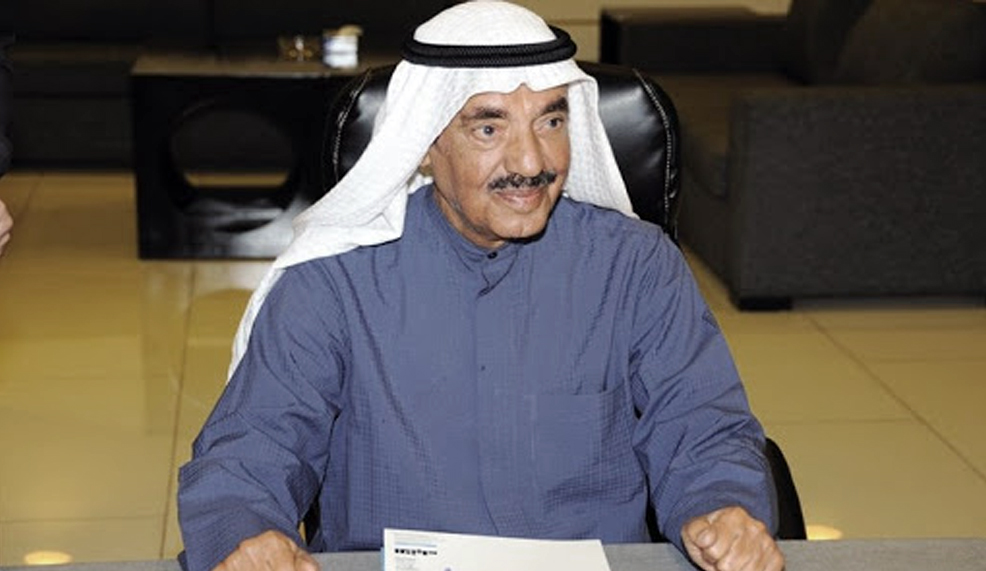
The panels reached Kuwait. The true art of Arabic calligraphy and the colours of Islam: translucent green, purple, a gentle blue, colours to soothe the soul and spread tranquillity, turquoise, pistachio and crimson. I recall the deep red and dark blue stained glass windows in churches and cathedrals. Colours of death and grief. The Kufan’s panels would be an addition to my other panels: the beautiful names of God by the Japanese calligrapher Honda, “I trusted in God” by the Chinese Hwang Su, and modern Persian calligraphy by the Iranian calligrapher Parviz. There are many distinctions: the quality of calligraphy lies in its firmness and strength, and unadorned colour acquires its beauty with no need for acclamation or embellishment. The lettering is of different types, and the decoration and gilding of the panels is of great originality, in the work of Kamal Boullata, Muhammad Said al-Sakkar and Mohammed al-Issawi, for example. But traditional calligraphy retains a majesty, firmness and coherence that present the eye with associations, psychological peace and harmony, and a beauty deeper than any decoration or embellishment, in terms of strength, spiritual depth and asceticism.
More than six months later, I was contacted by Yahya Ja’far, the Sakhr agent in Baghdad, who informed me that the calligrapher Jassim wanted me to call him. “I’ve made a present for you,” Jassim told me on the phone. “I went to the north myself and bought two pieces of marble which I engraved with your name, one in tughra script – and carving tughra script on marble is difficult, as you will see – and the other painted in traditional Islamic colours. This is a gift from me to you.” He added: “I just need you to pay the cost of the marble, 750 fils. Tell your friend in Baghdad to send it to me and collect the gift. I don’t want any payment for my work, it’s a present from me to you.”
The gift arrived in two heavy wooden boxes. I left them in a storeroom in a chalet in the seaside district of Bnaider, until I could find a suitable place to hang them. A year or more later, the armies invaded Kuwait and we were turned into refugees. A few months after the invading armies had left Kuwait, we went to the chalet, which had been cleared of mines, and found that everything had been burned — everything, my library, records, family albums, a manuscript poetry collection by my father, and two letters exchanged between my mother and Huda Shaarawi in the 1930s that had probably been burned for warmth. Luckily, I found the two wooden boxes still in place in the storeroom, perhaps because they were too heavy for the soldiers to move.
The war ended, Iraq was divided, and thousands of Iraqis left, fleeing in almost every direction. Jassim’s voice reached me from Amman. A sad, angry, hoarse and unsettling voice, staccato as a hail of bullets: “Iraq is divided, and I am in Amman now, I have no money and everything is dear here. I’m looking for work. Send me two or three hundred dollars quickly, I want my family to come with me.”
Seven or eight years later, we heard a knocking on the door before lunch, around noon, and a young man not yet twenty came in. I was standing in the reception room. I didn’t recognise him in the clean white thobe he was wearing. Wide black eyes, a thin moustache, and big black boots covered in dust like those of a defeated soldier. He held out his hand hesitantly in greeting: “Don’t you remember me?” I’m Mohammad, the son of the calligrapher, Jassim al-Kufi.” He spoke at length, lips trembling. I noticed he was sweating and that his hands were enormous, like those of his father. “My father died in Amman. He wanted us to come to him but he died and we don’t know where he was buried or who buried him.” He shook his head and his eyes – everyone’s eyes – misted over. He seemed disturbed as he continued talking while we stood there. His face began to wrinkle and zigzag lines started to appear on his forehead, as if he were anxious for the days to come. “My mother said to me: “Go to your father’s Kuwaiti friend, he might be able to help you.” Then he put his hand into his pocket and said: “I’ve brought you a present. You like raazqi. I collected them for you the day you visited our house and wanted to put them in your pocket.” Then he took out an envelope, which he carefully opened, and pulled out a thin white kerchief with white embroidery on it. Very carefully, he untied the threads, opened the kerchief and the smell of raazqi wafted through the room. A smell of paradise.
Translated by Paul Starkey
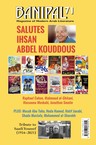
Published in Banipal 71 Salutes Ihsan Abdel Kouddous
Back to other Selections from Banipal 71
For news of readings, events and new titles.
The Cinderellas of Muscat by Huda Hamed (Banipal Books, 2025)
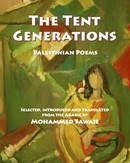
The Tent Generations
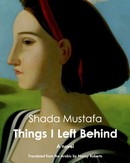
Things I Left Behind by Shada Mustafa, translated by Nancy Roberts
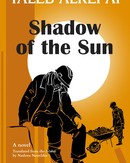
Shadow of the Sun by Taleb Alrefai
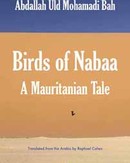
Birds of Nabaa, A Mauritanian Tale by Abdallah Uld Mohamadi Bah
The Stone Serpent, Barates of Palmyra’s Elegy for Regina his Beloved by Nouri Al-Jarrah
Mansi A Rare Man in His Own Way by Tayeb Saleh (Banipal Books, 2020)
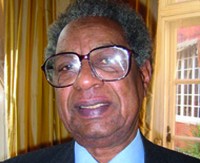
Tayeb Salih
Goat Mountain by Habib Selmi
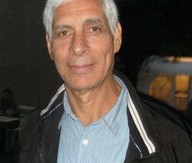
Habib Selmi, author of Goat Mountain and 3 times shortlisted for the IPAF
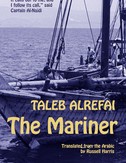
The Mariner by Taleb Alrefai (Banipal Books, 2020)
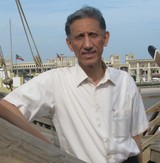
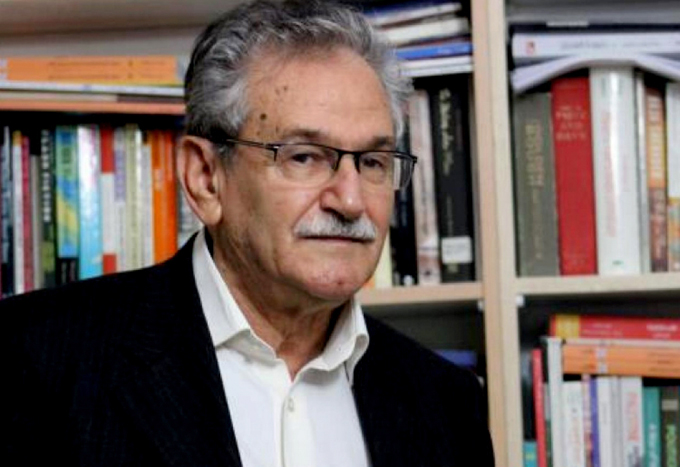
Taleb Alrefai, author of Shadow of the Sun and The Mariner
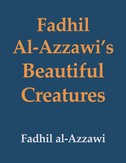
Fadhil Al-Azzawi's Beautiful Creatures by Fadhil al-Azzawi (Banipal Books, 2021)
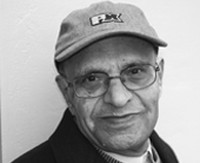
Fadhil al-Azzawi
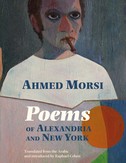
Poems of Alexandria and New York by Ahmed Morsi (Banipal Books, 2021)
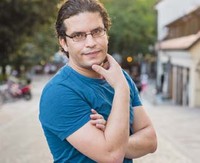
Saïd Khatibi
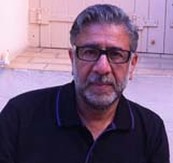
Amjad Nasser (1955–2019)

Digital Banipal the full archive
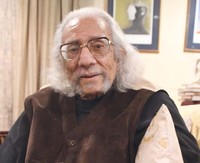
Ahmed Morsi, author of Poems of Alexandria and New York
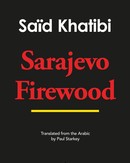
Sarajevo Firewood
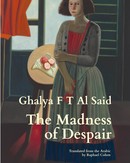
The Madness of Despair


.png)

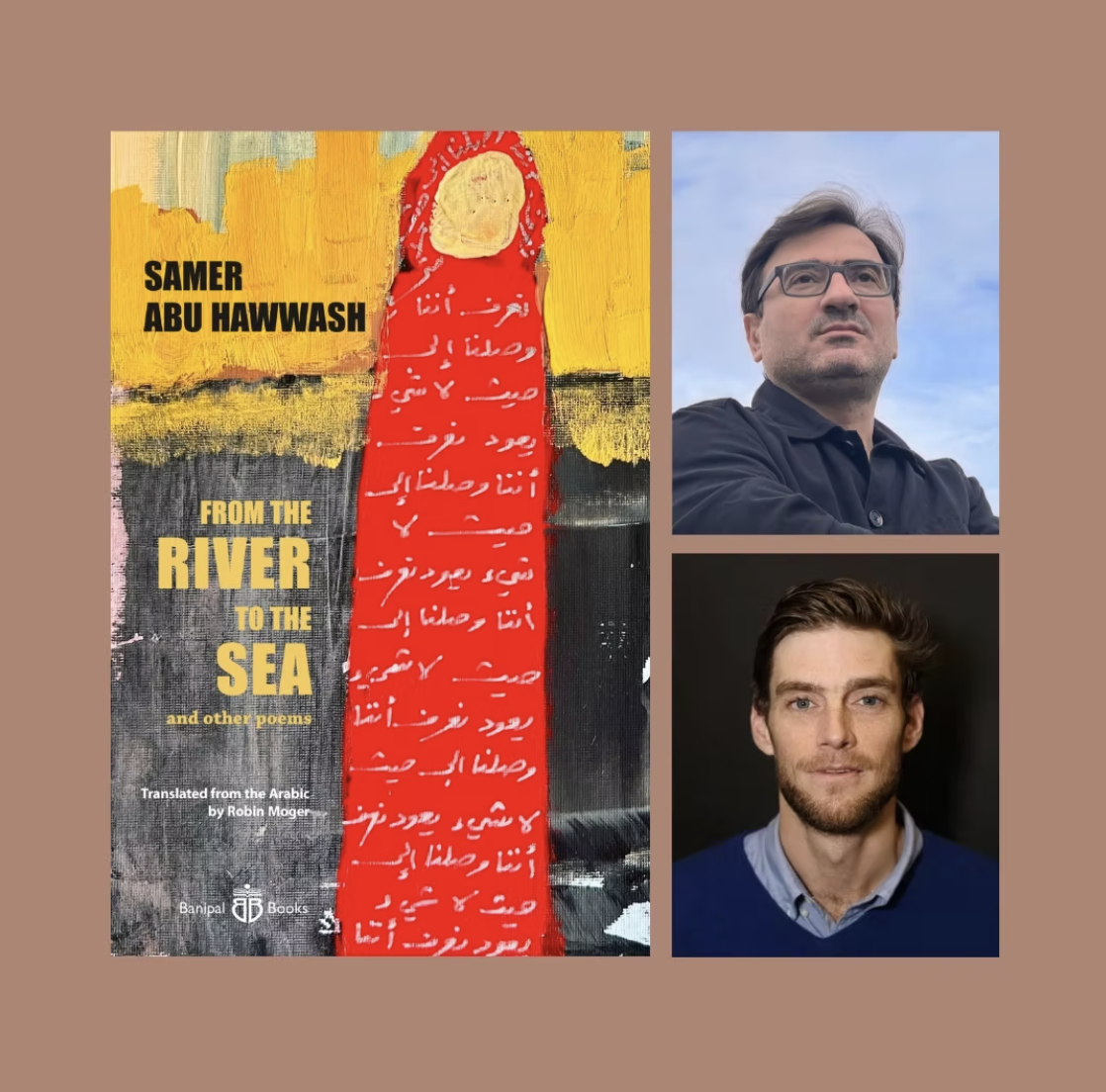
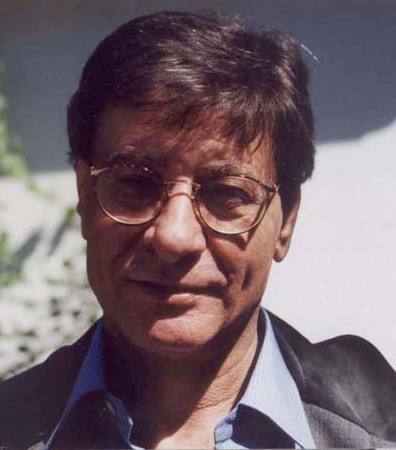
Link to poems by Mosab Abu Toha, published in Banipal 71 (Summer 2021), available to read online
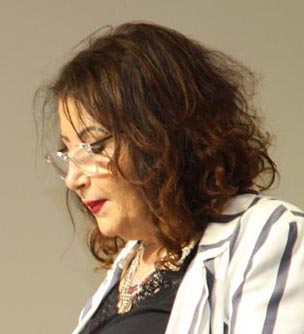
Link to poem by Liana Badr published in Banipal 74, now available as an online selection












* * *

 GRIFFIN PRIZE SHORTLIST 2023
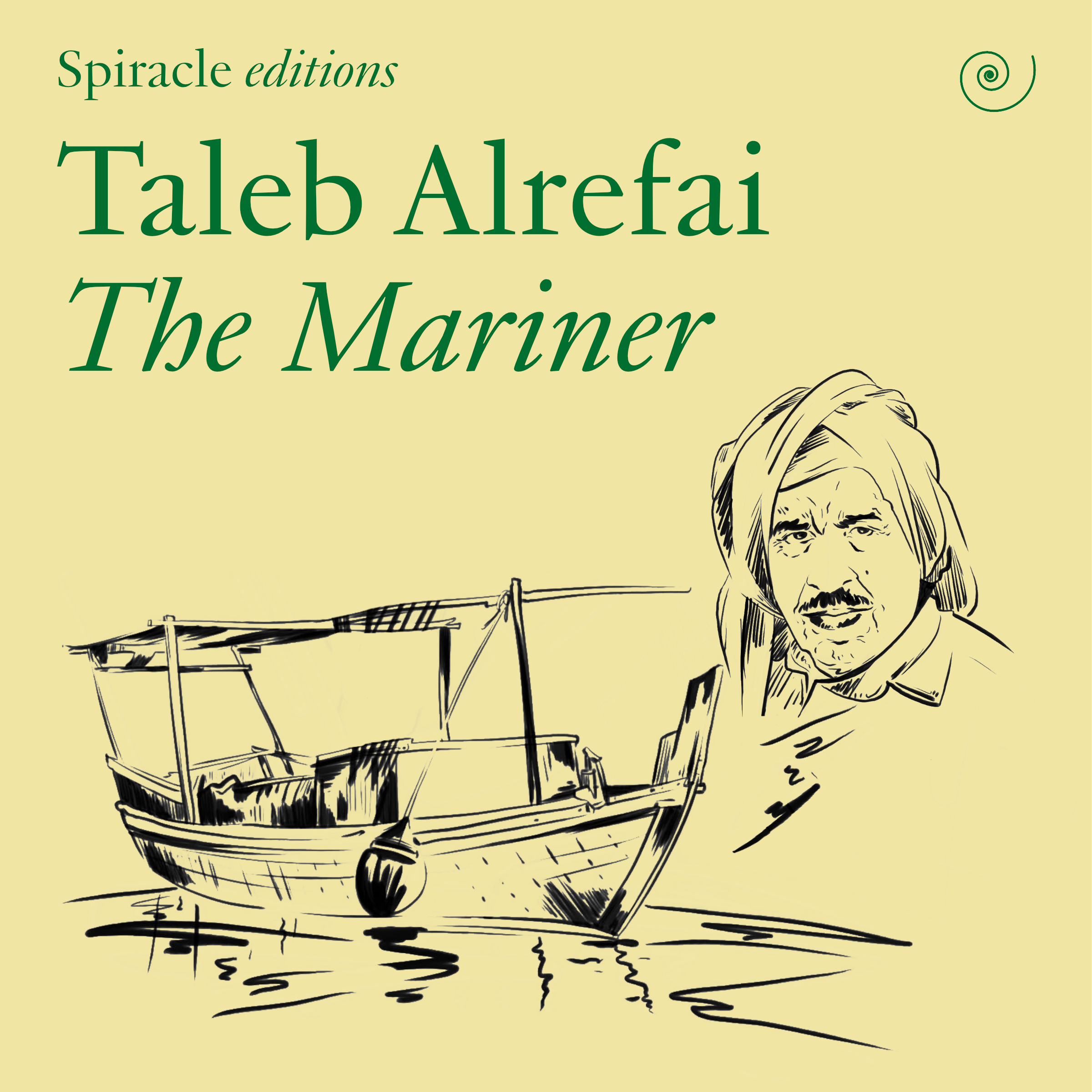 Banipal's first audiobook