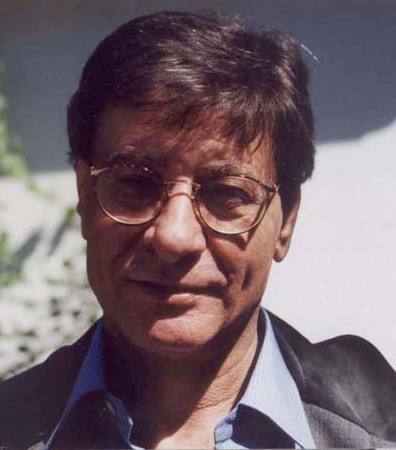
Last October Iraqi poet Khalid al-Maaly celebrated twenty years of his Arabic publishing house Manshoorat al-Jamal (Camel Publishing) in Cologne, Germany. Al-Maaly left Iraq in 1979, going first to Lebanon and then France, finally settling in Cologne in 1980.
Khalid al-Maaly was born in 1956 on the edge of the Iraqi desert, not far from the notorious Nugrat al-Salman prison. His semi-nomadic family travelled from one place to another in search of pasture for their herds of sheep until they settled during the mid-nineteen sixties in the small village of Abdul Hussain. Abdul Hussain was al-Maaly’s grandfather, and a train station would be named after him. Khalid al-Maaly grew up with many other siblings and half-siblings in a family – his father had four wives – whose most important source of revenue was animal farming. And so he drove his sheep and donkeys through the sparsely covered prairie around al-Samawa and tried to amuse himself by imitating all the Shia reciters of the tragedy of Karbala to which the family of the Prophet Mohammad fell victim.
However, he did not succeed in imitating those particular missionaries, and sought refuge at the gravestones of the holy Imams before he discovered classical Arab poetry and began reading poets such as Abu Tammam (788–845) and al-Mutanabbi (915-965).
After leaving school, he lived for a short while in Baghdad, but in this city, “infected” as it was by modern and European culture, the attraction of Baudelaire and Rimbaud was to prove stronger than that of the classical Arab authors. Al-Maaly was drawn inevitably to Paris – Tours and Poitiers – he was on the road there for some time. “But Paris offered no open arms for my dreams”, commented al-Maaly, “it resembled much more an ungrateful lover at whose side I had experienced the darkest days of my initial exile.”
He had to move on, and in the end settled in Cologne, Germany, where he still lives. “I would cut the night with wine and knives, and gaze quietly on that Cologne church, its days of glory long over,” recalls Khalid al-Maaly in his book Yowmiyaat Harb [War Diary].
Reading his poems, one asks oneself whether he has ever left the desert. The topography and perceptions of childhood can be discerned in nearly every line. And he says himself: “If I had stayed in Iraq I would obviously have been writing completely differently.”
Nearly 200 titles
While what one would term as progress in civilisation finds scarce resonance in his poetry, quite the contrary is the case with the books he publishes in his publishing house, al-Kamel Verlag, that he founded in 1983. “The books which I loved to read for so long I now wish to offer to the Arab public,” al-Maaly told me, and to date nearly two hundred titles have appeared from this one-man business, with around forty being translations from the German.
His titles are noteworthy for their distinctive quality and include – for the Arab world – a number of taboo-breakers, since Al-Maaly himself made up the list, that are familiar, above all to the Arabic censor. At many Arab book fairs, from under the counter al-Maaly passes to hungry Arab readers banned books such as [Sexuality among the Arabs], or [The Character of Mohammad] by the renowned Iraqi poet Marouf al-Rissafi (1874-1945), or works by the famous Saudi atheist Abdullah al-Qussaimi (1907-1996).
Also published by Al-Kamel Verlag – and so far as general Arab sensitivities are concerned rather unpleasant names – are translations of works by Nietzsche, Gottfried Benn [(1886-1957)], Georges Bataille [(1897-1962)] and G¸nter Grass, all finding readers in the increasingly introverted and traumatised Arab world.
Al-Maaly has managed to succeed in reconciling what are in him latent opposites, namely the poet and the merchant – a difficult balancing act between giving and taking.
Translated from the German by M Obank



.png)








 Reprint out now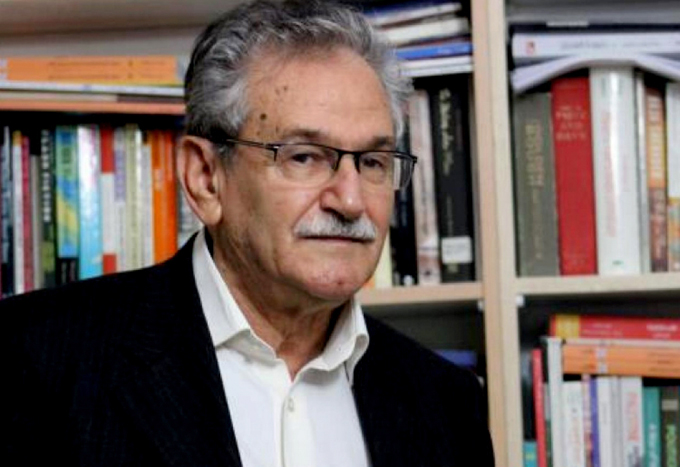
 GRIFFIN PRIZE SHORTLIST 2023
 Banipal's first audiobook