Receive Our Newsletter
For news of readings, events and new titles.

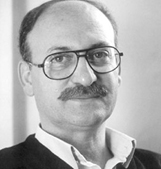
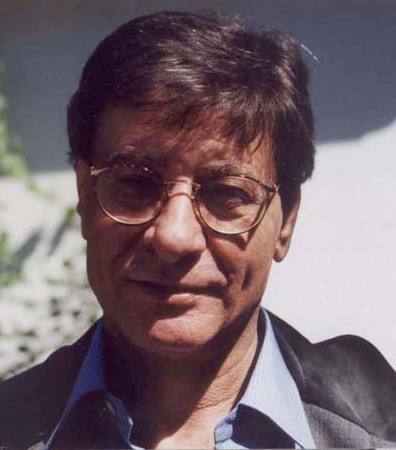
Throughout a creative career that spans about six decades, the Palestinian novelist and short story writer Mahmoud Shukair (b. 1941) has sought to give voice to his sufferings as a Palestinian battered by constant attempts to expunge his identity and appropriate his land and the place where he was born, lived and developed emotionally and culturally. The trauma he suffered at the age of seven in 1948, when Palestine was divided and the state of Israel was established, is central to the stories found in his narrative work about the city of Jerusalem, only a few miles from his own village, Jabel Mukaber, which escaped occupation in 1948 only to fall under Israeli control in 1967. Shukair faced the hardships of making a living, of daily life and political and party work, and of being affiliated to the left and to the Palestinian resistance movement, to which he devoted several years of his life. This led to the Israeli occupation authorities detaining him after 1967 and then expelling him from Jerusalem, though he returned to the city after the Oslo agreement. Yet despite those hardships, Shukair’s literary achievements, firstly in the form of short stories and later in novels and children’s writing, makes him a founder of Palestinian fiction. In the first five decades of his life he produced little work, but in the following decades, when he was free of his day job especially his political work, he produced a large number of narrative writings, including stories for children and young adults, using his memories of childhood and boyhood to examine the village – about which he wrote his best short stories and novels – striving to describe how Palestinians reacted to the disaster that struck them when their country was lost and parts fell under the control of other states – the West Bank annexed by Jordan, and the Gaza Strip placed under Egyptian administration.
Mahmoud Shukair started to have short stories published in the newspapers that sprang up in the eastern part of Jerusalem after the Nakba in 1948, as well as in al-Ufuq al-Jadid (New Horizon) magazine, which released its first issue in 1961. But his first collection of short stories, Khubz al-Akhareen (Other People’s Bread), did not come out until 1975, when it was published by a small Jerusalem publisher called Salaheddin Publishing after one of the streets in the holy city. The collection includes several stories that Shukair wrote before the occupation in 1967 and others written after the occupation that addressed the shock of Palestinians when what remained of Palestine fell under Israeli occupation. They also describe the development of the first seeds of resistance inside Palestinian society, which in twenty years had not yet fully digested the loss of Palestine. But the distinctive feature of this collection is its wit and humour and Shukair’s ability to portray village life in all its paradoxical diversity. He describes villagers who are shocked when they travel to the holy city and see a world that is different from their quiet, simple village where time seems frozen in comparison with the bustle and crowds of the city. There are country boys who go on pilgrimage to the city for pleasure or to work, young women ground down by life and forced to the city to sell the eggs, fruit and vegetables they have gathered in order to feed the hungry mouths in their families, and men who insist on visiting the al-Aqsa mosque but are shocked that the Israeli occupation forces prevent them from praying in the mosque sanctuary. Through a mosaic that contrasts the world of the village with the world of the city, the village boys and girls with the greed and cruelty of the city folk, and the Palestinians with the Israeli occupiers, Mahmoud Shukair seeks to portray the ordeals of Palestinians of all classes, without imposing any specific interpretation on the lived experience of his characters, whether as individuals or as a group. The occupation and the class struggle between the rich and the poor explain the suffering of Palestinians, men and women. The Israelis steal the land while exploitative bosses are responsible for the poor Palestinians who die of hunger or who collapse and die in the workshops of the city’s tall buildings. A class interpretation of the struggle, fed by the imagination of a storyteller who is armed with Marxist theory and a member of the Communist Party, does colour the world of Shukair’s short stories. But the stories seem more lively, more playful and humorous, and more able to capture the sense of paradox when they break free from this theoretical, scholastic and highly politicised approach, and set about portraying the characters as they are – women and men who want to live, love, enjoy themselves, progress, flourish and escape from the captivity of the small world that the village represents in contrast to the city, which is open-minded and noisy and promises pleasures and temptations.
In his next collection of short stories, Al-Walad al-Falastini (The Palestinian Boy, 1977), Shukair moves on to portray the incipient Palestinian resistance, both peaceful and armed, after Israel occupied the West Bank in 1967. At this stage, his work includes didacticism and a polemic that glorifies resistance and the refusal to abandon the land and go into exile, as happened in the Nakba in 1948 – equally a feature of the stories he wrote for children and young adults. But it also includes expressionist, symbolic language that is of a poetic nature and raises resistance to the level of Christian salvation and the prophetic spirit manifested in Christ’s sacrifice for the sake of humanity, the poor, the destitute, Palestinians and others – a Palestinian Christ in this case, who with his blood waters the land and makes it possible for the crops to grow. In his symbolic story “A Man Rose from the Dead”, which strikes me as central to his second collection, Mahmoud Shukair combines this Christian salvationist vision and a messianic vision of the world that is full of hope for the future, with the victory of good over evil and of the oppressed over those who dominate and humiliate them. In this salvationist vision we can detect a kind of belief in the peaceful resistance that Christ represents or the man who rose from the dead to spill his blood into the ground, which then turns green and fertile. This symbolises in a way the victory of peaceful resistance over armed resistance – at a time when the armed Palestinian resistance was reaching its peak in the first half of the 1970s.
But a sharp shift in Mahmoud Shukair’s experiment is detectable in the 1990s, when the writer sets aside the didactic tone that marked some of his stories and escaped from the thrall of the ideologically Marxist approach that had hampered his short-story writing and prevented him from portraying his characters with a lighter brush, as more vital and humane. He then was able to put some distance between them and the cursory, didactic and formulaic vision that turns characters into stereotypes reflecting the surfaces of things, not the depths and the diverse and complicated facts that are difficult to interpret and explain. That’s what we find, for example, is his collection Murour Khatif (A Rapid Passing, 2002), which contains a large number of micro stories, some of them limited to just a few lines or a page or two, with nothing superfluous or any explanation, interpretation or attempt to ideologise the world or force it into a single defined intellectual or interpretative mould. There are phenomena, events, images, and conversations that take place in front of our eyes, but the narrator does not comment on them. He presents them in a narrative that is hurried and economical and that allows readers to see for themselves what is hidden beneath the surface, or at least to see what the narrator has been through in the way of human experience and suffering in life.
This literary form takes these stories – those in this collection and in other collections in which Shukair experiments with this terse form of short-story writing – close to the realm of poetry, to the haiku form, or to the world of allegory and anecdote. But what matters most in this stage of Mahmoud Shukair’s development is that he has broken free from the didacticism of his previous stories and the weight of the ideological vision that they contained, and that he sets off into the wide-open spaces of creativity, where his characters face a puzzling world with uncertainty and ignorance. There is no ideologizing here, no stereotypes, no interpretation of the world, but rather a venture into the mysterious experience of living, in the face of which humans stand impotent, their hands tied as they confront the prospect of death and maybe annihilation, since “death crouches on the threshold like an old dog too weak to bark”, as the narrator says in one of the stories about an old man and his wife who are frozen in time, waiting for someone who doesn’t come.
In his later collections of stories, which came out in the early 2000s, Shukair reverts to the playfulness, humour, irony, and paradox that marked his first stories in the 1960s, in which fantasy, the exotic and the unexpected are the basic features that make up the events and characters and the daily interactions and conversations between them, with nothing projected from outside. His collection Surat Shakira (Shakira’s Picture, 2003) is full of stories about Palestinian villagers meeting, establishing relationships with or claiming to have relationships with international celebrities – politicians, singers, actors: Moratinos, Kofi Annan, Shakira, Brigitte Bardot, and Michael Jackson. It is a stinging satire about the reality of Palestinians’ lives under the Oslo Accords, which brought them nothing but visits by foreign officials, actors, singers and a few football stars. They visited the Palestinian Authority areas in trickles to express their solidarity while the occupation was building settlements and increasing the number of Israelis living on occupied Palestinian land and entrenching the permanent power of the Israeli occupation. Under these circumstances, in order to make life easier for one of his relatives, a member of the Shukair clan claims that Shakira is from the family in order to win the sympathy of an Israeli soldier who likes Shakira’s singing and dancing. The same interpretation applies when it comes to the other stories in the collection, which blend fact and fiction, imaginings and white lies in an attempt to give the mistaken impression that Palestinians have broken free of the occupation which, after the declaration of principles was signed by the Palestinians and the Israelis in 1993 and the Palestinian Authority was set up, continued to weigh on Palestinians, making their lives more difficult; in the meantime the land is being pulled out from under their feet and the occupation entrenches itself day after day.
But the harsh reality of life and the complicated lived experience of the Palestinian community in Jerusalem, the West Bank and the Gaza Strip are addressed in a humorous and lighthearted way that reveals the depth of the paradox, the bitter reality and the deep contradictions forming a deep fissure in the lives of Palestinians. It is reminiscent of another Palestinian writer, Emile Habiby (1921–1996), who adopted humour and the language of absurdity and parody, especially in his great novel, al-Waqai'a al-Ghariba fi Ikhtifa’ Said Abu al-Nahs al-Mutasha’il (1974) – its English title being The Secret Life of Saeed The Pessoptimist – as a way to portray passive resistance and the struggle to survive the Israeli plan to eradicate and appropriate the identity of the Palestinians who stayed within Israel’s 1948 borders.
Intertextuality with world literature and major writers and creative artists from the history of human storytelling gives another twist to Mahmoud Shukair’s experiment, thus aiming to show that the experiences of Palestinians have much in common with the experiences of other peoples who have lost out in other languages and cultures. This is what we find in his collection Ihtimalat Tafifa (Slight Possibilities, 2006), which uses the micro story to express these narrative and existential inter-sectionalities, either through the message that the stories convey or through the parallels that they establish between the protagonist who seems to be central to all the scenes that make up this collection of short stories and the character of Don Quixote (Cervantes, 1547–1616) or of the Good Soldier Svejk in the novel of that name by Jaroslav Hasek (1883–1923). The character whose exploits Shukair chronicles is similar to the knight of La Mancha who tilts with windmills, while the Palestinian knight carries his lance through a modern city in the belief that the war is still raging. This knight, who is reminiscent of Don Quixote, lives in a world of ideals that have disappeared, and roams around in a city where are there no longer any fighters, in a reference to the current reality of Palestinians and their successive defeats. These micro stories are explained by a quotation from Don Quixote at the start of the first part of Shukair’s collection: “Yesterday I was king of Spain, today not of a single town; yesterday I had towns and castles; today I possess none”. At the same time, the stories have scenes in which Don Quixote in his guise as a modern Palestinian meets the Good Soldier Svejk in a street in Prague and the latter confides in him that he is busy stealing dogs, which he sells in order to make a living.
Elsewhere this collection of stories sets up an intertextual parallel with Habiby’s novel The Pessoptimist, in a clear allusion to the fate that awaits the Palestinians in their territories occupied after 1967. The Palestinian knight, who carries his lance in a city that no longer wants war, has no other recourse but cunning, humour, passive resistance and keeping a low profile in order to go on living. One of these stories combines all three characters: Don Quixote, the Good Soldier Svejk and Emile Habiby’s Pessoptimist:
I stopped at the first street, looking in all directions. Just at that moment trucks full of soldiers with weapons and ammunition drove by. Don Quixote went by on horseback, with his squire behind him on the back of a donkey. The Good Soldier Svejk walked past, with his thin nose and small eyes. A man passed who was looking around in all directions like me. He told me he had to live by his wits in order to stay in the country. His name was Said Aboul Nahs the Pessoptimist. I shook his hand and said, “I’m called Said too!” Then he walked on and I kept looking around in all directions.
Published in Banipal 70 – Mahmoud Shukair, Writing Jerusalem
Translated by Jonathan Wright
Back to Banipal 70 contents page
For news of readings, events and new titles.
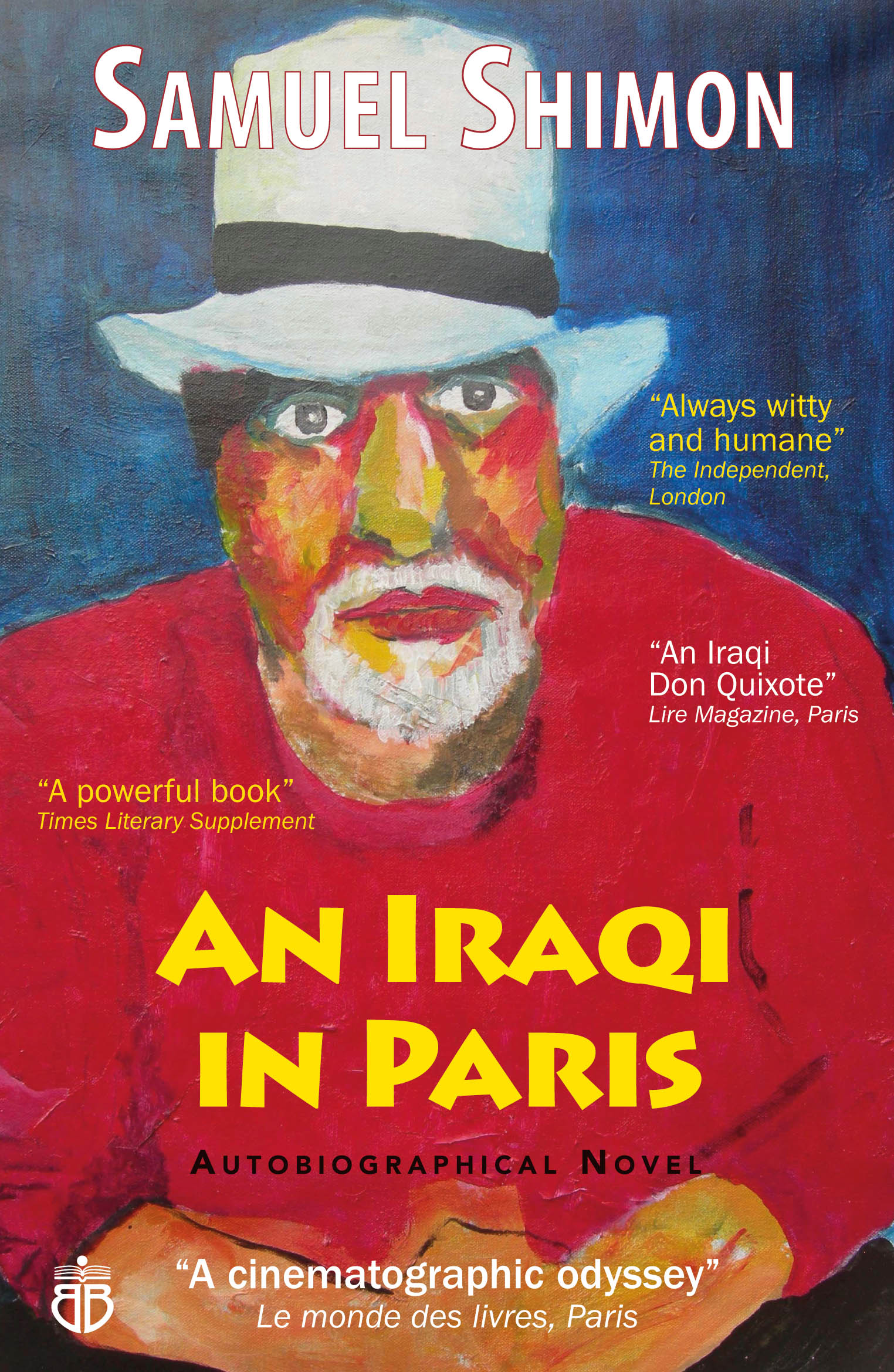
An Iraqi in Paris by Samuel Shimon
The Cinderellas of Muscat by Huda Hamed (Banipal Books, 2025)
The Tent Generations
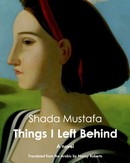
Things I Left Behind by Shada Mustafa, translated by Nancy Roberts
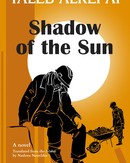
Shadow of the Sun by Taleb Alrefai
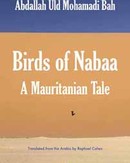
Birds of Nabaa, A Mauritanian Tale by Abdallah Uld Mohamadi Bah
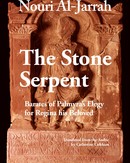
The Stone Serpent, Barates of Palmyra’s Elegy for Regina his Beloved by Nouri Al-Jarrah
Mansi A Rare Man in His Own Way by Tayeb Saleh (Banipal Books, 2020)
Tayeb Salih
Goat Mountain by Habib Selmi
Habib Selmi, author of Goat Mountain and 3 times shortlisted for the IPAF

The Mariner by Taleb Alrefai (Banipal Books, 2020)

Taleb Alrefai, author of Shadow of the Sun and The Mariner

Fadhil Al-Azzawi's Beautiful Creatures by Fadhil al-Azzawi (Banipal Books, 2021)

Fadhil al-Azzawi
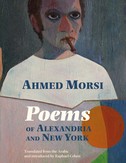
Poems of Alexandria and New York by Ahmed Morsi (Banipal Books, 2021)

Saïd Khatibi
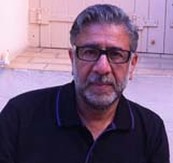
Amjad Nasser (1955–2019)

Digital Banipal the full archive
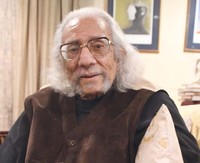
Ahmed Morsi, author of Poems of Alexandria and New York

Sarajevo Firewood
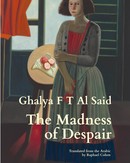
The Madness of Despair


.png)





Link to poems by Mosab Abu Toha, published in Banipal 71 (Summer 2021), available to read online

Link to poem by Liana Badr published in Banipal 74, now available as an online selection






















* * *



















 Reprint out now
 GRIFFIN PRIZE SHORTLIST 2023
 Banipal's first audiobook