Receive Our Newsletter
For news of readings, events and new titles.

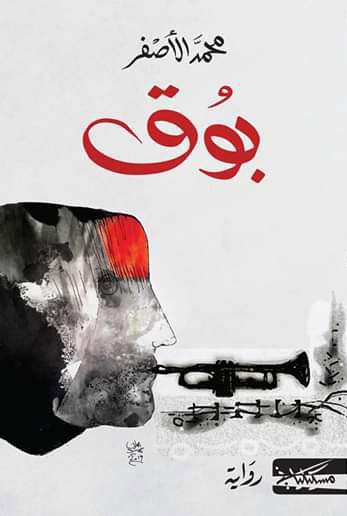 Fayez Ghazi reviews
Published by Dar Masciliani,
Tunis, 2020.
ISBN: 978-9938-24-083-2. Pbk, 173 pages.
This novel by the Libyan writer and novelist Mohammad al-Asfar, executed on paper, bears a dual purpose. On the one hand, it is a token of the author’s loyalty and gratitude to Germany, the adoptive home that embraced him. On the other, it juxtaposes love and hate, war and peace. The writer elicits two temporal handshakes, first between Germany and Libya through his use of the fortress of Tobruk, home to the remains of German soldiers who fell in Libya during World War II, and between East and West through the language of music, so far removed from the human calamities of racism and tyranny.
It begins with a well: a symbol of life in the arid desert, from which a German soldier, Karl, is reborn. Karl has closed his eyes on the retreat from battle, surrounded by the sounds of gun and cannon fire, and opened them to hospitable Bedouins who have rescued and taken care of him. How will they communicate? Through music: the only universal human language. “Blow, man, life is a breath from the mouth of the Lord.”
This new life demands a new kind of birth; a different kind of baptism. This brings us to a cave in the mountainside, into which Karl moves in order to inaugurate a lifestyle utterly detached from his old one. Only the trumpet remains, as a thread connecting the scattered parts of his soul between Bonn and Tobruk, gathered together by the four movements of Beethoven’s Ninth Symphony. Music, as a language of love, is also what attracts a Bedouin shepherdess to the cave, and Karl is drawn to her. With this rebirth, a new name must also be written on a new Libyan ID card: not “Karl” but “David”, a reference to King David, who introduced the Psalms in the Old Testament and played the flute.
And because the past must return, Carla then arrives in Tobruk to search for the bodies of German soldiers and give them a proper burial. In need of a translator, she is referred to Karl – her old lover, whom she thought had died in the war and whose body she was set to bury alongside those of his brothers-in-arms. A pleasant surprise, amid many days marked by the search for body parts and the construction of a Germanic style castle-cemetery on a hill overlooking the city and sea. They recall the years gone by; the beautiful memories they shared on the Rhine and in Bonn, as well as the sad ones, including the rape she was subjected to at the hands of Allied soldiers after the fall of Germany, and a failed romance with the postman.
Carla’s mission ends. The warm farewell between them lasts all of a day and night in the hotel. Karl refuses to return to Germany, preferring to stay in Libya alongside those who saved and loved him, and with the departed souls of his friends who fell in battle.
History is ever-present in the novel, and so we also see one “Sheikh Miftah” holding forth on the strong relationship with Germany ever since the rescue of Sheikh Ahmed Sharif as-Senussi, who led the jihad in eastern Libya against the Italians at the beginning of the twentieth century. This comes in addition to the good comportment in trade exchanges between Bedouins and German soldiers during the war, in addition to linguistic similarities between the Garamantes people, who built the ancient Libyan city of Germa, and modern-day Germans.
The novel promotes a message of peace between East and West, and between all humans, through music. This is manifest in the imaginary scene the writer conjures up for the dead soldiers, who advance from the castle at its inauguration: soldiers who fought and killed one another in life and whose souls are reconciled in death. It also comes to the fore in the relationship between Karl and the shepherdess, whom he teaches to play, building bridges to her through musical notes. The novel also carries a note of regret, or self-examination, by Karl for his role in the war. He reaches the conclusion that music was not created to perpetrate injustice, and that from his brass instrument there ought to issue forth melodies, not fire. “Art must bleed the future balm,” al-Asfar writes, “the preventative balm that will spare the universe from new catastrophes worse than those that came before.”
The novel is compelling, with its lovely language, events and smooth-running scenes. It is punctuated by the pain of conflict, killing and loss, and ends with a Greek-style tragedy in a minefield dating back to World War II – death, for the freedom of a young buck. The author does not conclude the novel with this dark disaster, though, but rather has the shepherdess play a final, melodious tribute to Carla’s soul in the present world, and to Karl’s in the hereafter. The scene brings the brunette and the blonde together around the coffin of Karl/David, born in Germany and buried in Libya, who in his lifetime has united East and West through music.
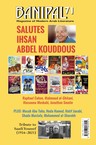
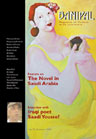
Published in Banipal 71 Salutes Ihsan Abdel Kouddous
Back to other Book Reviews
For news of readings, events and new titles.

The Cinderellas of Muscat by Huda Hamed (Banipal Books, 2025)
The Tent Generations
Things I Left Behind by Shada Mustafa, translated by Nancy Roberts
Shadow of the Sun by Taleb Alrefai

Birds of Nabaa, A Mauritanian Tale by Abdallah Uld Mohamadi Bah
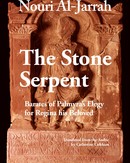
The Stone Serpent, Barates of Palmyra’s Elegy for Regina his Beloved by Nouri Al-Jarrah

Mansi A Rare Man in His Own Way by Tayeb Saleh (Banipal Books, 2020)

Tayeb Salih
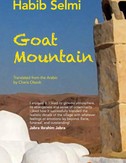
Goat Mountain by Habib Selmi
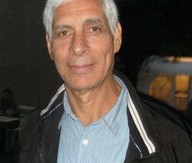
Habib Selmi, author of Goat Mountain and 3 times shortlisted for the IPAF

The Mariner by Taleb Alrefai (Banipal Books, 2020)

Taleb Alrefai, author of Shadow of the Sun and The Mariner

Fadhil Al-Azzawi's Beautiful Creatures by Fadhil al-Azzawi (Banipal Books, 2021)

Fadhil al-Azzawi

Poems of Alexandria and New York by Ahmed Morsi (Banipal Books, 2021)

Saïd Khatibi

Amjad Nasser (1955–2019)

Digital Banipal the full archive
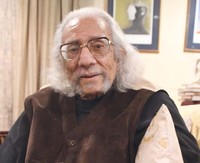
Ahmed Morsi, author of Poems of Alexandria and New York

Sarajevo Firewood
The Madness of Despair



.png)





Link to poems by Mosab Abu Toha, published in Banipal 71 (Summer 2021), available to read online

Link to poem by Liana Badr published in Banipal 74, now available as an online selection






















* * *
























 GRIFFIN PRIZE SHORTLIST 2023
 Banipal's first audiobook