Receive Our Newsletter
For news of readings, events and new titles.


RAOUF MOUSAAD BASTA
(20 March 1937 – 18 October 2025)
EXCERPTS FROM THE NOVEL
THE OSTRICH EGG
TRANSLATED BY PIERS AMODIA
THE CHASE
The servant rested the palm fibre broom against the chair and stopped behind the boy who was bent over, intent on leafing through a picture book. Quite oblivious to the delicate movements, he was taken by surprise when the servant pressed his body up against his own. He tried to escape but the servant trapped him between his thighs, placing one hand over the boy’s mouth while with the other lifting his tunic.
Thus the servant brought an end to the situation that had developed between the two over the course of a chase that had lasted one long week. The servant – not more than seventeen years old – had been working in the house for about a fortnight. The boy’s mother, ever busy about her spacious home, would try and keep her eye on her son all the time but he would run away: she would call him and he wouldn’t answer. Sometimes she’d send the servant to look for him and when he found him he’d sneak up behind him and embrace him. At times the boy would push the servant away and scratch his face, at others he’d ignore him as the servant, still hugging him, dragged him slowly in the direction of his mother’s voice. Then the servant would let him go and remain nearby watching to see if, this time, the boy complained about him. But the boy never did.
There was a silent complicity between the two. The servant would discover the boy’s hiding place and embrace him, sometimes sitting him on his lap; the boy would behave as if nothing was happening, but then pull back at the last moment before his immature mind was obliged to recognise what really was happening. But when the servant himself gave up hope and held back for a few days it was the boy who, feeling abandoned, began to flirt with him, rubbing up against him, hiding his things and following him around the house. Until that day when the servant put an end to the chase, caught his prey and, for a few brief moments, felt that he was the master.
* * *
THE MADNESS OF TIMSAH
THE CROCODILE
Once a month my father traveled from Wad Medani where we lived, to southern Sudan where he attended meetings and met with foreign missionaries and other Egyptian priests. Sometimes he brought back with him groups of people from the south who had been evangelised and converted to Christianity. One of these was Timsah the Crocodile who, having become a Christian, took the name of Joseph. He had a sad face and wore clean clothes – a ragged short sleeved shirt and faded khaki shorts – and on Sundays would stick his flat feet into a pair of Bata plimsolls. Joseph the Crocodile was taken on as our servant for house and church, but he began to spend most of his time in the church when it was empty, polishing the seats and dusting the bibles. My mother didn’t realise, but we discovered that he had begun to eat prayer books and New Testaments, after which he started gulping down the nails and bolts from the pulpit. And so the day came when they took Joseph the Crocodile away in a police car – there were no establishments or ambulances for the insane in Madani in those days – and Timsah disappeared with a look of pained surprise on his face.
* * *
FIRST DISCOVERY
How my mother, the peasant, cheated God on High
I was sitting one afternoon at the doorway of our home open onto the street watching the passers-by. A few boys were standing in the street in front of the church, spitting, and I watched them with surprise as they drew a cross in the earth with their feet. I looked on in fascination: some of them I knew from school, a few had their dicks in their hands as they danced and shouted: “Christians are good . . . for firewood.”
My father would pray with us every morning after breakfast, then around the lunch table. He also taught us to pray “Our Father Who art in heaven” by ourselves before going to sleep. Even in Assiut, where I attended high school at the American College, there was no escape from prayers: before breakfast, before lunch, before dinner, on Saturday evening, on Sunday morning and evening, and every day during first break. Of course the prefect was always on hand to register the names of those present, as well as of any absentees, who would subsequently be punished . . . and of course as soon as the prayers began to weigh upon my spirit I learnt to avoid them, and to think up ways to evade punishment.
I joyfully participated in corrupting the daughter of Father Ibrahim. He taught, to all the classes in school, a subject called “social sciences”, the aim of which was to make children aware of the harmful effects of masturbation and the evils of socialism.
The priest’s daughter was like a mare in heat. She’d leave her home near the students’ dormitories and head for the Ibrahimiyya irrigation canal where she’d meet with some of the older boys in the shade of a thicket of trees. We younger boys would, after lengthy negotiations, be allowed to stay in the vicinity to look on, and of course we watched attentively. She always wore a red dress. She walked in rapid strides and had a serious but pretty face, but as soon as she lay back on the ground among the boys her laughter would ring out like the peals of a silver bell, or so at least it seemed to me. I worshipped her. She was about seventeen years old then, I thirteen. Before leaving the American College at the age of nearly sixteen I used blackmail for the first time in my life in order to have her.
* * *
IS IT POSSIBLE TO MARCH IN A DEMONSTRATION WITHOUT CONTEMPLATING THE BUTTOCKS OF THE GIRLS IN FRONT OF YOU?
Baghdad – 1977
There was a demonstration to protest against the Camp David Agreement which had been signed by Anwar Sadat. All of us, Egyptian workers and students in Iraq, marched together towards the Egyptian embassy. That’s when I saw her, or rather the first thing I saw were two round buttocks under a pair of grey flannel trousers. I was just a few steps from that backside and hurried closer in order to see the face of its owner. It was Yamama, a medical student. I knew her father slightly and asked myself reproachfully how I had managed not to notice her before. Her buttocks rose and fell, undulated and quivered, and I said to myself that if Yamama had nothing else but them she would lack nothing, but it happened that she also had a beautiful face and great deep honey-coloured innocent eyes that emphasised her feminine body.
The demonstration ended as expected and we parted, but my vibrations had entered her orbit. We exchanged a few remarks, the darkish complexion of her face blushing with emotion and trickling sweat which collected on her slightly protruding upper lip then dripped down over her neck and made her thin white blouse adhere to her small breasts (small that is in comparison with her buttocks). Her small feet matched well with her behind, her waist was slim and well defined, her back graceful and harmonious. The smell of her body was one of cleanliness intermingled with the smell of her excitement, tension and sweat.
I knew that that evening she would go to the Egyptian students’ club, so I went there too in order to meet her. After that we began using any excuse to meet and a silent complicity developed between us. She told me that she was in love with a colleague of hers, an Iraqi Assyrian Christian, but that his family was making their life hell, and she asked me to help arrange their meetings, to become their telephonic go-between. She knew I was married to a Polish woman who lived in Warsaw, and I was ready to do anything in order to remain in her orbit. I would telephone the guy and we’d wait for him together in the lobby of the Abbassi Hotel. When he arrived, I’d sit with them for a few minutes before withdrawing like a true gentleman. Sometimes, however, she and I would give him the slip and retire far from the prying eyes of friends and acquaintances. Little by little her meetings with her friend became more and more infrequent.
At about that time, as the Baghdad summer sank over us, we began to arrange a trip to Cuba to participate in a youth festival in Havana. She volunteered to help me prepare the papers for the delegation I was leading and for that reason we spent a lot of time together. One hot afternoon Yamama took me back to my flat in her father’s car. She complained she had a headache and I suggested that she come up and rest a little. She stretched out on the sofa in the living room as I turned on the air conditioning and went into the kitchen to prepare a cup of tea for her. Tears were running silently down her cheeks. I knelt beside her and embraced her, then kissed her (for the first time) devouring her tears and her lips as she entered my embrace. I drew her down next to me on the floor rubbing my hands across her body as she wept silently on my neck. I did nothing – not because she stopped me or because I stopped myself, but because I felt our relationship had entered a new phase. She recovered her gaiety and liveliness, got up and wandered barefoot around the flat, she even went into the bedroom and to make up the bed.
We began looking out for any opportunity to meet in my flat. We’d throw off our clothes, take a cold shower then stretch out on the bed under the hum of the air conditioning. We’d explore one another but without going too far, indeed we had decided by unspoken agreement to get to know one another more deeply and to leave the final penetration of the delta for Havana. What’s the harm in a little romance before her body enters a new phase? Or so, at least, I thought to myself.
Yamama told me about her complex relationship with her mother. Her father, a man in his fifties, had become embroiled in an affair with a younger woman. He had told his wife and asked for a divorce but she had had a nervous breakdown and was taken into hospital. Yamama told me clearly of her sympathy for her father and for his right to live with whom he pleased. In the end, though, he had given in to social pressure, broken off his relationship with his lover and returned to his wife with his tail between his legs.
You can imagine Yamama’s position. Perhaps she was looking for the lost image of her father in me. I was some twenty years older than her. From the beginning I had treated her compassionately and had sympathised with her love for the Assyrian, despite the knot in my heart. She was alone even during the time of her inconclusive relationship with him, and we would sit together for hours as I listened to her. I didn’t feign compassion for her, on the contrary our daily semi-public relationship had become indispensable to me in the barren emotional desert of Iraq. She told me of her little adventures, of the beginnings of her knowledge of the male body, of the naïve attempt by one of her girlfriends to establish a sexual relationship with her. I was the first person she spoke to and I was fascinated by her and by her life. At the time she was no more than twenty-two years old.
On that warm and drizzly tropical morning in Havana we slipped away from the others and caught a bus headed for the seaside, staying on board until the end of the line. Once there I bucked up the courage to ask the driver if he could guide us to a nearby hotel. His mulatto features lit up in a knowing grin and he led us in person to some wooden cabins where he conferred unintelligibly with a young and fat black woman, explaining our requirements. She shook her head in a sign of approval, laughing, and led us to a room with a window overlooking the ocean. I closed the blinds and we hoisted sail; my ship entered into a warm and willing port. She was my first virgin. When we went to the black woman to pay the bill she offered us sweet ice-cold watermelon. As we made our way back by taxi, Yamama asked: “Is it finished? Is that it?” We laughed for a long time.
* * *
Medinet Habu –
west of Luxor 1983
I was in the shadowy hallway, illuminated only by the light of the moon coming in from the desert across the Valley of the Queens, sitting at the far end in the dark and gazing at the winged serpent coiled around the God Aten on the façade of the temple in front, the temple of Medinet Habu on the west bank of the Nile near Luxor. Seated alone in the dark, having sought my own company, I was sipping warm white wine and smoking, watching the moon slowly get closer to the serpent’s wing. From the room in the back on the right – Angelina’s room – I could hear the giggles of the two girls, followed by the squeaking of the brass bed. From time to time I heard them groaning, a strange sound in the atmosphere of the hallway like cries for help in an unknown language.
I heard the noise of a car pulling up below and recognised Eleanor’s deep voice say something to which a man, probably the taxi driver, replied: “Okay.” The car drove off and I drew back into the shadows listening to the sound of Eleanor’s heels on the stone steps. From my hiding place I could see her loose white summer dress fluttering and exposing the nudity of her long white thighs. Carefully, she approached the room that echoed with the sound of sighs and moans, and I held my breath as she removed her shoes and crept towards the window, poking her blond head through the opening. Fascinated, I contemplated her pleasure as she began to gyrate her hips around her waist and to pant hoarsely, her pelvis acquiring a life of its own. Suddenly she stiffened – like an animal sensing a distant danger – as she found me standing behind her, but I didn’t touch her. We exchanged a long stare charged with the significance of the sudden discovery of our mutual shame and complicity. I pressed up against her from behind and a short silent struggle began between us though we did not look at one another directly. Each of us remained in our place, I tried to take her and she to repel me. The two girls were still in the room, and their voices and the movements of their bodies – reaching us through the open window – provided the necessary backdrop for Eleanor’s gradual surrender.
I was sitting in the garden of the Winter Palace Hotel, before me a bottle of beer, a packet of cigarettes and a few newspapers. A number of female tourists were wandering around aimlessly. My seat was not far from the road and nearby were two lads from Luxor on the lookout for prey. Their coarse primitive faces exuded the smell of cheap cologne and their eyes had a hungry look, glittering as they saw two women by themselves. “Hello honey,” they cried. The women tittered and the two lads swooped down like hawks.
Having had dinner and drunk all the beer we could we walked back in the direction of our hotel. The dogs were sleeping in their lairs and the moon illuminated the potholes in the road. We accompanied Judith, who likes to sleep early, back to the hotel where Angelina hugged her and gave her a long kiss on the lips. We waited for the elderly night watchman to open the inner door and let Judith in up the dark stairway, then we set out for the appointment I had organised with the Master of the Ghurza. We had arranged to go the abandoned village of Qurna where, next to the mosque, we would meet the guide who would lead us to the mountain.
“Are you sure you want to do this?” I asked Angelina as we were approaching the abandoned village, and she silently squeezed my arm by way of response. We found the boy, his face veiled to the eyes, then without exchanging a word climbed the narrow stony crisscross paths to the cave hewn into the mountainside. The boy left us at the mouth of the cave which to me seemed like the tomb, or the entrance to the tomb, of a Pharaoh. From within we could hear a woman’s voice inviting us to enter. The interior was semicircular and the woman was sitting in the middle facing the entrance; to her right were two men, very black as if from Nubia or Sudan, and naked apart from triangular leather loincloths hung with seashells, silver chains and brass rings. Their faces were lined but their bodies were slim and strongly muscled, and shone with the effect of unguents or of sweat, or perhaps of both. To the woman’s left, sitting cross-legged on a lambskin rug dyed red, black and green, was a girl with a tawny complexion and black hair hanging loose over her shoulders and down to her breasts. Her eyes, heavily made up with kohl, were gazing at the glowing brazier standing in front of the woman who, from time to time, would throw in sticks of incense sending wreaths of smoke up towards the domed roof of the cave. Facing the woman was a dark-skinned boy, perhaps seventeen or eighteen years old and naked, sitting with his legs stretched out before him and tightly pressed together, which served to emphasise his erection. We sat in the spot the woman indicated, between her and the boy.
Then the girl began to chant in a language I didn’t understand, a soft flowing chant rising in a crescendo. The two men looked towards the woman who raised her right hand, then they began to beat their feet on the ground as the woman prostrated herself in the direction of the chanting girl. She then saluted towards the four corners of the cave – seeking leave from the lord of the north and the lord of the south, from the lord of the east and the lord of the west, from the god of wind and rain, from the crocodile of the river and the snake of the desert – and began crawling, prostrate, in circles towards the naked boy. The two men followed her, one to either side and at least a pace behind, maintaining a distance between her and themselves. Before the woman could reach the naked boy the girl let out a shriek and the woman froze in her place as the two men leapt upon her and stopped still at the level of her head. The girl wailed as the two men danced violently shaking their various chains, rings and seashells which emitted a sound like the rustling of the leaves and branches of a tree. The woman, still prostrate, began to retreat. Her haunches were raised above her head and gyrated to the rhythm of the dancing feet, the movement of which caused her to crawl backwards. I gazed at the boy: his large eyes were immobile, a light tremor ran through his frame beginning from the feet and rising like a wave through legs, waist, stomach, chest and neck and his body, anchored only by head and feet, rose and fell from the earth. The woman crawled backwards towards the girl who rose upright and opened her legs. The woman then put her head between the feet of the girl who swayed her trunk forwards and backwards with the two men on either side of her.
Three times the woman returned to the boy, and three times the men did what they had done before. She then crouched in her original position as the girl began dancing towards the boy, advancing in a straight line and moving only her haunches; at the same time she raised her flowing dress and tied it above her waist. Underneath she wore nothing and her naked thighs, stomach and buttocks were exposed. The two men danced in front of her leading her to the boy, but a few steps before reaching him they stopped suddenly and began shaking their bodies violently, their rings emitting a sound like the roar of an infuriated bull. The woman pulled out a tambourine and began beating out a rapid and regular rhythm. The girl stood over the boy’s body; at first over his feet, his body in the space between her open legs, then moving forwards shaking her hips until coming to a halt over his head. The boy began to moan, his body moving in harmony with the movements of hers, but without the two touching. The girl, still dancing, then retreated until stopping over the boy’s hips. The two men accelerated the rhythm of sounds, their chains shaking violently with the movement of their bodies. The boy’s entire body was undulating with a tremor that shook him from head to foot. The girl’s body was also shaking and had lost the harmony of its movements as if she was now in a rush to reach a conclusion. She was emitting short consecutive sighs, pants and gasps. The woman raised her tambourine. The two men leapt. The boy’s body rose and fell. The girl leapt away from the boy as his frame rose up into a great arch, stiff, tense and vibrating, at the very moment that the white sperm spurted out, spotted with blood.
The two men carried the girl outside while the woman hurried to the boy, covering him and taking him in her arms. He curled up sobbing as she rocked him back and forth with those calm and regular movement that mothers use to send their babies to sleep. The woman indicated that we should leave and so we did, standing near the entrance to the cave in the cold and stinging mountain wind. The guide with the veiled face came and led us away to the summit of a small hill where the girl was standing naked, her face turned towards the moon, muttering incantations. Behind her the two men, one to each side, held her by her fully-outstretched arms. She leant forwards taut like a bowstring, and every time she reclined back the man on the right would hit her with a piece of leather below the belly, the man on the left across the breasts. When the moon began to disappear behind the black clouds, the two men picked her up and disappeared into the dark.
* * *
DIARY
March 1983
I met today with my friend S. A., and told him of my desire to write a book about the various uses that can be made of the body. I also told him that I wanted to write about prison – he had been with me in Wahat, and before that in Qantar and other prisons – and about the relationships some prisoners establish with one another. He didn’t like the idea of discussing such a subject, saying that the police and other hostile groups would seize the opportunity to denigrate communists and democrats, who are regularly sent to jail in our country.
I tried to explain to him my idea that the body is the only thing that remains to an inmate after the prison authorities have taken away everything else: papers, books, letters, clothes, even the hair from his head. In other words his very identity. Nothing of his own remains save his mind and his body and, I added, the authorities try to take even the body by banning all forms of privacy: collective showers, toilets without doors, buckets of shit in cells that are kept closed for twenty hours a day, letters censored both going out and coming in.
In such circumstances the attempt by a political prisoner – and here I emphasised the “political” – to use his body to preserve his invalidated humanity, to find an opening for his longing to bestow and receive love, to give to a chosen individual – and here I noted the principle of individual choice, entirely lacking from daily life in jail – gives him a very special opportunity to use his body to express his possession of his self and his soul.
My friend was not convinced, despite the fact he is a famous writer. I know he was moved by moral and political considerations, but it is my belief that anyone who wants to write must necessarily maintain a distance between his writing and his principles, and that he may sometimes find himself far from those principles, exactly as happens with the secret actions of our lives.
* * *
HOW THE BRANCHES OF THE TREE OF THE HOLY FAMILY FELL
The desert bus left Midan Tahrir for Alexandria. I was headed there in search of solace and consolation, of conversation with people who were finally happy to accept me as I am, with all my defects.
My little sister now lives in the flat once occupied by my mother, after my brother – married and now a father – moved to another apartment in the Boulkly district. She married, without the consent of the family, while I was in prison. Her children have grown up and her husband died one morning in the bathroom. She recently remarried secretly with a Muslim colleague of hers; her children were against the match and the secrecy was because my sister was afraid that the “Holy Family”, as we used to call our family, would also oppose it. My mother, before she died, was reconciled with her and my brother let her have the flat because she was living with husband and children in a gloomy basement. Her daughter has graduated and married, and lives and works in Marsa Matruh near the Libyan border.
My big sister emigrated with her husband and children to Canada where she gained a new citizenship. My big brother also emigrated, to America, where he too obtained citizenship and where his two sons are serving in the US military. He himself sent them into the army after they finished high school because, being extremely avaricious, he begrudged putting his hand in his pocket for their university fees, when the army would pay for their studies in exchange for calling them up in time of need. I heard that one of them was with the US forces during the Gulf War. My brother the teacher works in Zambia, while his wife and children live in Alexandria. I sometimes go and visit them when he is on summer leave.
The house of my maternal uncles and aunts is in the Sidi Jaber al-Sheikh district. Their street used to be called Dantimaro to honour the memory of the foreign engineer who supervised the construction of Alexandria’s famous Corniche, but in the latest wave of Islamisation the provincial authorities gave it an Arabic name, that of an unknown figure whose identity neither I nor my uncle, who has lived there for more than twenty years, have been able to discover. The flat has remained the same ever since my elder uncle moved to Alexandria in the mid-1950s: a third-floor flat on a street near the shore where, on quiet nights, I can hear the lapping of the sea.
With the death of Aunt Lulu the girls’ room became Aunt Regina’s. Uncle Wadie used to sleep in the room near the sea but after his death they used it to keep all those ancient odds and ends, broken and useless, that tend to accumulate in houses and occupy the little empty space available. With the demise of Uncle Naguib, Uncle Shakir would have remained alone in the room the two of them used to share had Aunt Regina not moved from her own room to occupy the empty bed in his.
The door of the flat opens onto the entrance hall where an old dining table would be covered with newspapers at mealtimes. The hall gives onto a small and simple kitchen, next to that is the lavatory which has been leaking water from the flush for years. The other hall is used to receive guests, except that it’s a long time since any guests have arrived; not for any specific reason but simply because all the family acquaintances are either emigrated, ill or dead. The “guests” who still do arrive are the doctor, who comes regularly, the priest who makes an appearance once a month, and a neighbour or two for illnesses and feast days. Most of them prefer to sit in the bedroom where they can substitute conversation with watching the television, which has been kept there ever since my elder uncle’s day.
Despite the lack of light, the windows and shutters being closed summer and winter; despite the incessant noise of water from the leaky lavatory and the smell of medicines hanging in the musty air; despite last year’s calendar hanging on the wall, which no-one had taken the trouble to change; despite all these things I would go to visit as often as I could. Breathless after the long climb up the ancient and gloomy stairway, I would ring the bell and a voice from within would answer: “Who’s there?” “Me,” I replied. Slowly the various and complex locks and chains that protected the two inhabitants from the dangers and surprises of the night would be opened and I would go in to find them both in the bedroom, stretched out in their beds, the mattresses of which were hard and rigid with humidity, age and neglect. The television did its duty by exonerating them from the need to speak to one another. They would doze and drop off to sleep then suddenly one of the two would pronounce a phrase that had been in his head for hours, but the other would not reply: there was no question that merited an answer and anyway neither could be bothered.
They were bound by mutual fondness and affection. Out of his hearing she would say to me: “I look after him, he doesn’t even know how to make a cup of tea,” and when she wasn’t around, he would say: “She has no-one else, I help her with the chores.”
Of the two it was he who was telling the truth, as most of the time her rheumatism prevented her from moving and he would go down to buy ful beans, fresh bread and the newspaper, which he would study with care and intelligence.
The guest room contained a third-grade certificate “in appreciation of outstanding service while working for the Aswan Dam Corporation between 1958 and 1962” and every morning he would sit under the certificate wearing his street clothes and reading the paper. He would ask me about Islamist groups and give me the latest news and rumours about fires in churches and attacks on Coptic shopkeepers. He wasn’t afraid but he was concerned and he didn’t understand what was happening. I tried to lighten the rumours, which were usually exaggerated, and he would pretend to believe me.
Neither of us wanted to argue about the subject so we would seek another that would not lead to discussion but, rather, give scope to his ironic sense of humour. I would draw him, with his consent, into telling me “Stories of the Holy Family” and he would begin to eulogise my father and, very slightly, to criticise my mother, recalling her arguments with my Uncle Wadie in Sudan. Is it true, he would ask me, that your late Uncle Wadie used to go with a Jewish girl? He asked the question seriously and I would answer equally seriously trying to remember the details I’d invented the last time he asked. Gradually, though, I discovered that he wasn’t so much concerned with verifying the story as with reliving that episode from his brother’s sex life, an enigmatic affair that had caused a great stir at the time, more than forty years ago now. My uncle was concerned, in his own particular way, with the details of the Jewish girl: Was she beautiful? Tall or short? Her age. The colour of her skin. I had learnt to remember the main thread of the story, but each time I would introduce new variations, and he never pulled me up, not once. He was an excellent listener. We would sit on the old sofa from Assiut facing the photos of his dead relatives and mine – his mother and brothers, my mother and uncles, my grandmother and aunt – and talk about them without restraint, with love, a little irony and forgiveness for their defects.
Sometimes my aunt would join the conversation. She had never married. Initially, my uncles had decided not to get wed until their two sisters were married, then they decided not to marry at all so the girls would not be offended by their sisters-in-law. Aunt Lulu died followed by my other uncles and now only Aunt Regina was left, along with Uncle Salib, known as Shakir. My uncles’ decision not to marry before their sisters is a tradition among Christians in Upper Egypt. The sisters though, with the exception of my mother, remained spinsters.
I don’t remember ever hearing a single word of complaint from my uncles, or seeing any harshness in their treatment of my aunts. The only one in the entire family who used to complain was my mother, but when I said as much to them they were quick to find excuses for her.
* * *
THE STORY OF THE TWO GIRLS FROM THE BOUTIQUE IN ZAMALEK
In Zamalek, on the ground floor of the building I lived in, was a small boutique where two girls worked, Nadia and Ferial. I used to see them at lunchtimes sitting in the entrance to the shop: Nadia, dark and slim, always wearing slippers and swaying her body as she walked; Ferial, pale, petit and plump. They were perhaps about eighteen years old and lived in the City of the Dead, that of the Imam al-Shafi’i as I learnt later, home to immigrants and to Cairenes driven from their homes by legal measures taken during the final years of the Sadat government.
The owner of the boutique was a corpulent middle-aged Syrian with a high voice. When he was in the shop the girls became very docile and compliant, but when they were alone and without customers I used to find them relaxed, all slippers and smiles. At first we simply exchanged pleasantries but my eye had been on them for some time and I felt it would be possible to establish a relationship.
It was Nadia who took the initiative, accosting me at midday one day as I was coming home with a bag of mangoes. “Who eats alone eats badly,” she said.
“You’re welcome to join me,” I replied.
She approached hesitantly and seized two mangoes: “One for me and one for Ferial.”
“I want to see you,” I told her and she replied: “I’ll come up tomorrow morning.”
I asked her at what time and she said: “early, before work.”
I agreed, reluctantly because I don’t like to meet people in the morning, be it for work or sex, but I knew she arrived at the shop early, so what could I do?
She came next morning at about eight when I had just got out of bed and wasn’t in a good mood, nonetheless I offered her a cup of tea. “Do you live in this huge place all by yourself?” she asked (the “huge place” was two small rooms and a lounge), not expecting a reply. She discovered the bedroom, and called me there saying: “Come on, quickly!”
“Not now,” I replied, “perhaps some other time.”
I realised I had upset her but justified myself by saying I was expecting some people round. I gave her two guineas and said: “Come later, about lunchtime, and bring your colleague with you.” They appeared at midday, giggling to one another but behaving quite normally as they explored the flat together, commenting cheerfully on the many books and the few pictures it contained. “You’re throwing your money away on that stuff,” they told me, “if you don’t know how to spend it on something useful, give it to us and we’ll spend it.” The three of us had lunch together, then Nadia called me into the kitchen and said: “Where’s my present? I brought you the girl.”
I promised to give her five guineas, and she asked: “And how much will you give her?”
“I don’t know, what do you think?”
“Don’t give her too much, five is enough for her.” Then she added: “By the way, she’s not a virgin.” That morning Nadia had told me that she herself was a virgin but that she could pleasure me more than other women.
I had expected Nadia to leave but instead she followed us into the bedroom. Ferial, genuinely abashed, hesitated to take off her clothes but Nadia treated her roughly and she put up no opposition to such treatment. Nadia also took off her clothes, to my surprise and pleasure, and the three of us went to bed together. I noticed that Nadia was gazing at Ferial’s body with desire. She didn’t give us the chance to do anything but immediately divided her attentions between the two of us. After a little while Ferial rebelled and tried to free herself from Nadia’s clutches but in the end she realised what she wanted and surrendered herself to the two of us.
I sent them away after paying them both the same amount.
It was a trifling sum, I thought after they’d left, but they were happy with it. They represented a new type of girl, one that had appeared over the last twenty years and that I didn’t know. They worked in the boutique ten hours a day, except Fridays. Nadia told me that her mother worked as a cleaner in the same building, while Ferial’s father had a small wooden kiosk on the corner selling cigarettes, newspapers and cold drinks.
They began coming round regularly, sometimes alone, sometimes just for a few minutes chat or to “borrow” a guinea or two. Our relationship developed to the point that we were almost friends.
Then one day the owner of the boutique disappeared suddenly, and the police came and put seals on the door. I learnt from the proliferating rumours that he had been arrested for drug dealing. The two girls also disappeared.
Years later I was walking in Midan Tahrir when I saw Nadia on the arm of a rustic-looking young man (rustic-looking in the sense that he was wearing frightful European-style clothes). We exchanged a brief glance. She shook her head by way of warning and greeting, and a fleeting happy smile appeared on her thick sensual lips. The other, Ferial, I never saw again.
I remember that Ferial once told me she lost her virginity when she was fourteen or fifteen years old. “I can’t remember,” she said, “it was more or less then, is it important?” According to her account, she used to sleep between her two brothers, one older than her the other younger. At first it was the elder brother who raped her. This went on for some months and he would beat her if she refused him, in fact he would beat her for any reason at all. Then the younger brother also began to demand his rights, and they shared her between them, sometimes more than once a night.
She answered my persistent questions calmly, even a little bored.
“Okay, but what did your parents do?”
“They slept in the same room with us.”
“And didn’t you say anything to your mother?”
“At first I was scared, then … khallas.”
“What do you mean, khallas?”
“That’s it, they’re still my brothers after all, and in any case it’s normal.”
“What does normal mean?”
“Normal means normal, and in any case I’m better off than others, there are girls in my neighbourhood whose fathers and uncles sleep with them. That really is a sin.”
Translated from Baydhat al-Na’amah,
2nd edition, Madbouli Bookshop, Cairo, 2000.
First edition, Riadh el-Rayyes, London, 1994
Published in Banipal Magazine 30 – Celebrating Ten Years (Autumn/Winter 2007)
For news of readings, events and new titles.

The Cinderellas of Muscat by Huda Hamed (Banipal Books, 2025)

The Tent Generations

Things I Left Behind by Shada Mustafa, translated by Nancy Roberts

Shadow of the Sun by Taleb Alrefai

Birds of Nabaa, A Mauritanian Tale by Abdallah Uld Mohamadi Bah
The Stone Serpent, Barates of Palmyra’s Elegy for Regina his Beloved by Nouri Al-Jarrah

Mansi A Rare Man in His Own Way by Tayeb Saleh (Banipal Books, 2020)

Tayeb Salih
Goat Mountain by Habib Selmi

Habib Selmi, author of Goat Mountain and 3 times shortlisted for the IPAF

The Mariner by Taleb Alrefai (Banipal Books, 2020)

Taleb Alrefai, author of Shadow of the Sun and The Mariner

Fadhil Al-Azzawi's Beautiful Creatures by Fadhil al-Azzawi (Banipal Books, 2021)

Fadhil al-Azzawi

Poems of Alexandria and New York by Ahmed Morsi (Banipal Books, 2021)

Saïd Khatibi

Amjad Nasser (1955–2019)

Digital Banipal the full archive
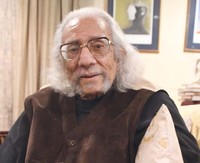
Ahmed Morsi, author of Poems of Alexandria and New York

Sarajevo Firewood

The Madness of Despair




.png)











Link to poems by Mosab Abu Toha, published in Banipal 71 (Summer 2021), available to read online

Link to poem by Liana Badr published in Banipal 74, now available as an online selection

























* * *










































 GRIFFIN PRIZE SHORTLIST 2023
 Banipal's first audiobook