Receive Our Newsletter
For news of readings, events and new titles.

Ammar Almamoun reviews
Sanderellat Masqat
(The Cinderellas of Muscat)
by Huda Hamed
Published by Dar al-Adab, 2016
ISBN: 978-9953-89-523-9
What if Muscat lost its magic?
Modernity has killed off magic in our world, or to be more precise and to use critical terminology, modernity has left our world disenchanted, without fairy tales. We are victims of a world that is carefully regulated and measured, designed for the habitual existence of daily life, not a world where we can dream or imagine different worlds. It’s a world where all we do is work in line with the fictions of profit and loss associated with our work. The Omani writer Huda Hamed refers to this common trap at the start of her novel The Cinderellas of Muscat, published by Dar al-Adab in 2016.
The disenchantment began in the public arena, with the arrival of electricity and power stations that through wires made their way into every home. “The female jinn abandoned Muscat ever since it was lit by electric lights, and ever since people hardened in their concrete homes, while the racket made by their air conditioners and the voices coming from the television sets were louder than the voices of the jinn,” she writes. Although those mythical, magical creatures could change the world, or at least the life of an individual, with just a few words, Hamed reveals how magical incantations have been replaced by advertisements, TV shows and films that don’t even promise a better life but set limits on our imaginations and recycle existing stereotypes.
Hamed posits an alternative in the tradition of oral storytelling and its association with magical worlds. The Cinderellas gather in a restaurant to escape their daily lives, to chat and reveal their secrets. They are not looking for a prince but, as housewives, they are seizing the chance to enjoy a few hours of independence before midnight comes. They say what is in their hearts, far from the cares of their homes, husbands and children. This storytelling reveals to us the roles that women play in private spaces, submissive to their husbands and their families. Their bodies wear out and show signs of housework, and each of them has a secret that threatens the aspect of themselves that is visible in public, as if this space for storytelling, in a restaurant in the presence of Ramon the chef, is a time outside ordinary time, a time when each of them becomes a princess and can get hidden feelings off her chest.
Although Hamed offers the reader refined, trimmed versions of fairy stories and a melange of Cinderella fables, there is a tremor of fear that runs through the novel, even in the conversations between the women, because some secrets, if divulged, could lead to the collapse of the women’s houses, metaphorically and literally. They seem to have independence only in those hours of storytelling – hours that evoke the past and revive stories of the past in the face of the “modern” world in conventional time, which imposes on women roles as mothers, housewives, obedient wives and devoted daughters – all of them social roles that revolve around domestic space.
Later in the novel, and I say this without wishing to spoil anything for readers, we discover that the stories we are reading are only a trick, a way to fight both forgetfulness brought on by disease and traditional forgetfulness, because the power of repeated storytelling is the women’s means of escape when they are unable to change their circumstances. The stories must continue to be passed on orally so they do not die, and the hope of change remains alive. Here we can understand the beginning of the story: television replaces personal stories with dubious melodramatic fictions that present images to the imagination without nourishing it. Hamed draws an analogy between the destructive power of television and the concrete used to build houses: it kills the spirit of those who live in them and confines them to enclosed spaces, of various dimensions, in which they are imprisoned on the pretext that “this is where they live”. This sense of confinement is at the centre of the novel. The women go into houses/cages, and do not come out of them except through their stories.
We learn about the past of each of the women and then about the changes that came about when they got married or when they were in their family home. There is always an exceptional event that takes place in the home and that sticks in the women’s memories to such an extent that it is passed on as a rumour or as something scandalous. Regardless, the social ideology surrounding the concept of home presents it as a pristine ideal that should not be questioned. However troubled someone might be when they go in, when they come out they must preserve the ideal. This social pressure acts on the Cinderellas, not through the power of “modernism” , i.e. the power of work and new roles, but through the coercion of the outside world and its gaze.
This outside world takes the form of the rumours of neighbours, relatives and the tight circle of acquaintances, the people who resort to prying, speculating and gossiping in order to create a policing authority that surrounds every woman. A sporty husband, to give one example, even if he is unfaithful, is still the head of the household and a role model in people’s eyes, and the daughter who is robbed of her life because of her mother’s illness also tries to maintain her image and not to reveal to her neighbours the hardship she has endured. This extends to bodies too: even if the external appearance changes completely, the old images remain present, as in the story of Fathiyya, who discovers that her past in inescapable because the time when she submitted to a man’s power can’t be forgotten, and even if she herself has suppressed the memory, her past clings to her and is passed on by other people’s tongues. Fathiyya is haunted by a photograph of her father in which she also appears, taken at a time when she was plumper. All the years she has spent toning her body and burning pictures of her former self count for nothing when she sees the picture of herself as a fat girl with her family and her ghost father. There was a choice to be made: to preserve the image of the father or to tear up the picture and protect Fathiyya’s feelings. The authority of ghosts is stronger than the authority of the living and the photograph is still in place near the entrance to Fathiyya’s home.
There are no male saviours in the novel and no princesses. It is even in doubt whether Ramon the chef is real or the result of some magic. So there is no promise of change, no magic formula. There is just the storytelling and the disclosure of things that have been suppressed, which can then feed into the mana* of the world – that force that moves and brings similar people together out of fear or solidarity. We also feel that storytelling is contagious and has magical powers, because we discover later that Ramon himself, who at first wants to learn recipes from the Cinderellas, also wants to know their secrets – it’s an opportunity that he will never have again, and so he has to seize it in order to confirm a belief that he had abandoned – are the jinn real or just folk tales?
The novel relies on psychological transformations and the effects of magic and storytelling on women who wait for the moment to get out of the house at a particular time and live as princesses if only for a few hours in a restaurant. Through this plot device, Hamed deviates from the tradition associated with women abandoning their homes, an act that means emancipation from traditional authorities, and entering that world of “modernity”, which the women never refer to – the world of work and material and emotional independence, the world where feelings are not secrets, but facts on the basis of which one acts in order to protect and build one’s self.
At the end of the novel we discover that the desire to tell stories and disclose secrets is only a seed that later grows into a passion for writing things down that arises from a personal weakness in one of the woman. This woman is frightened of forgetting, not because no one had heard her stories or her friends’ stories, and not because she is afraid of losing her home, but because of Alzheimer’s. Forgetting is inevitable for a genetic reason that is the opposite of magic. There are simply no words and no medicine that can cure or reverse this condition. Alzheimer’s destroys awareness of the world and drives the sufferer of the disease into a domain where imagination, fact and memory mix and overlap, so much so that doubt becomes a question.
* Mana: in the culture of the Melanesians and Polynesians, mana is the spiritual life force or healing power that permeates the universe. Anyone or anything can have mana. It is the cultivation or possession of energy and power, rather than being a source of power. (Wikipedia)
 Reviewed in Banipal 71 Salutes Ihsan Abdel Kouddous, Summer 2021
pages 44-48, along with an extract from the novel, translated by Chip Rossetti.
The English edition of The Cinderellas of Muscat, translated by Chip Rossetti, will be published in May 2025 by Banipal Books, see https://www.banipal.co.uk/banipal_books/131/the-cinderellas-of-muscat/
Back to Book Reviews
For news of readings, events and new titles.
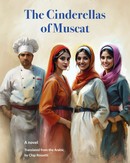
The Cinderellas of Muscat by Huda Hamed (Banipal Books, 2025)
The Tent Generations
Things I Left Behind by Shada Mustafa, translated by Nancy Roberts

Shadow of the Sun by Taleb Alrefai

Birds of Nabaa, A Mauritanian Tale by Abdallah Uld Mohamadi Bah

The Stone Serpent, Barates of Palmyra’s Elegy for Regina his Beloved by Nouri Al-Jarrah

Mansi A Rare Man in His Own Way by Tayeb Saleh (Banipal Books, 2020)

Tayeb Salih

Goat Mountain by Habib Selmi

Habib Selmi, author of Goat Mountain and 3 times shortlisted for the IPAF

The Mariner by Taleb Alrefai (Banipal Books, 2020)

Taleb Alrefai, author of Shadow of the Sun and The Mariner

Fadhil Al-Azzawi's Beautiful Creatures by Fadhil al-Azzawi (Banipal Books, 2021)

Fadhil al-Azzawi

Poems of Alexandria and New York by Ahmed Morsi (Banipal Books, 2021)

Saïd Khatibi

Amjad Nasser (1955–2019)

Digital Banipal the full archive

Ahmed Morsi, author of Poems of Alexandria and New York

Sarajevo Firewood
The Madness of Despair




.png)









Link to poems by Mosab Abu Toha, published in Banipal 71 (Summer 2021), available to read online

Link to poem by Liana Badr published in Banipal 74, now available as an online selection
























* * *



























 GRIFFIN PRIZE SHORTLIST 2023
 Banipal's first audiobook